


- 30-second summary
- Is Micromoola worth your time?
- 120 reviews that nobody can verify
- The $50 task that pays $100
- What Micromoola actually is
- Open spots that shrink, then vanish
- 3 payout timelines on 1 website
- What you can realistically earn
- A blank jurisdiction in the Terms
- Who should try Micromoola
- Frequently asked questions
- Sources
30-second summary
According to its own pages, the platform pays cash via PayPal with a $5 minimum, and the Walmart Shopping Run concept (full reimbursement plus a bonus) is genuinely appealing for US-based shoppers.
However, the site contradicts itself on the flagship payout ($50 vs. $100), claims 120 reviews that exist nowhere on the internet, and after 11 months of operation still has an unfilled legal placeholder in its Terms of Service.
Pros
- Cash to PayPal, $5 minimum
- No fees, no points, no gift cards
- Free signup, no SSN required
- Shopping run pays bonus + full reimbursement
Cons
- Zero independent reviews exist
- Zero non-US tasks during testing
- Homepage contradicts itself on payout
- Terms contain unfilled legal placeholder
Is Micromoola worth your time?
Yes, if you are a US-based shopper who wants a quick one-off payout with zero startup cost, as long as you accept that task availability is limited, the platform has no verifiable track record, and your earnings depend entirely on whether a slot happens to be open when you check.
However, if you want income that doesn't vanish when a platform changes its rules, limits your geography, or shuts down without warning, this isn't the right path. To build a long-term digital asset that grows over time and isn't controlled by a third party, explore my guide on how to earn money by displaying ads on your website.
120 reviews that nobody can verify
Micromoola's homepage and footer display a badge reading "★★★★★ 4.8 average from 120 reviews." Six testimonials appear on the homepage, each attributed to a first name and last initial (Melissa R., Dana W., Chris T., Priya K., Jordan M., Ashley B.). None include a date, a link to an external profile, or any way to confirm the person exists.
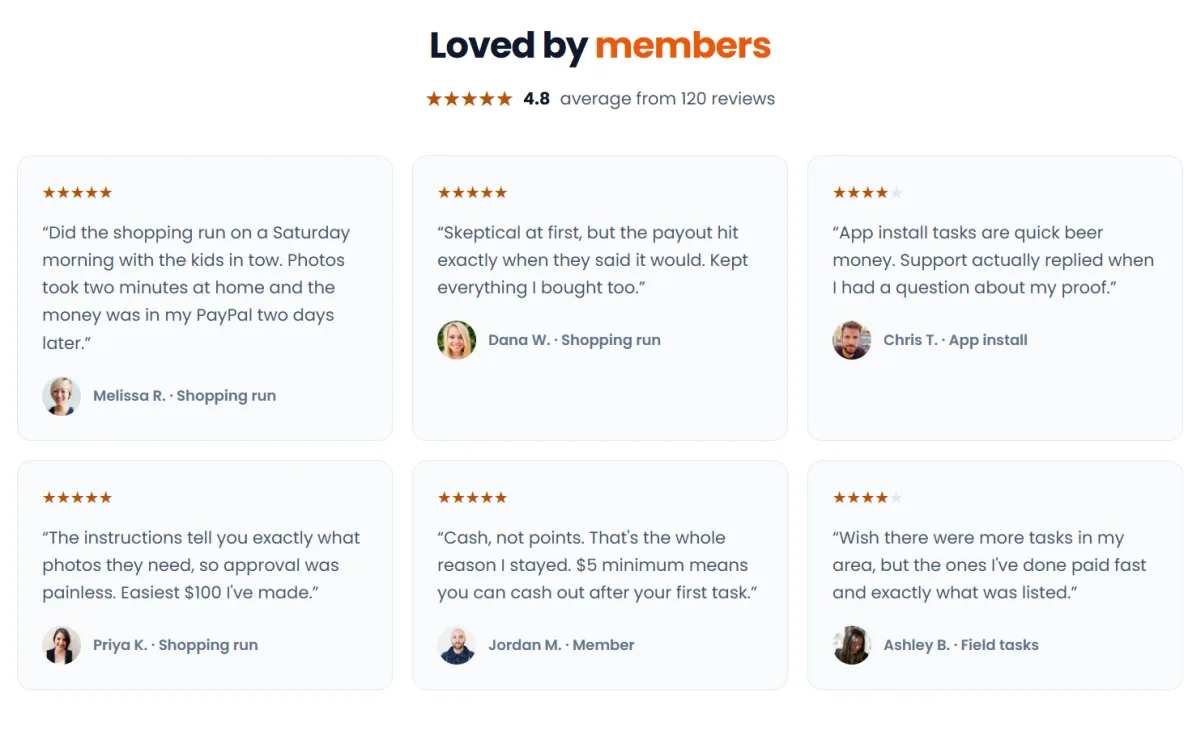
The remaining 114 reviews are nowhere to be found. There is no Trustpilot page, no G2 listing, no Reddit thread with verified user experiences. A search for "Micromoola" on Google returns the message "Showing results for Micromalla. Search instead for Micromoola" — meaning Google treats the brand name as a misspelling of something else entirely.
The only external mentions found are two Reddit threads where users ask about experiences with Micromoola. In neither thread has anyone replied with an actual experience. After 11 months of operation, the platform has produced zero independently verifiable user feedback outside its own website.
To be clear: this does not prove the reviews are fake. It does mean that the "4.8 stars from 120 reviews" claim is currently unverifiable by any third party. The platform's own FAQ and blog repeatedly encourage skeptics to "do one small task, cash out at $5, and check your PayPal" — effectively acknowledging that no external proof exists and asking users to generate their own.
The $50 task that pays $100
Micromoola's flagship task is the Walmart Shopping Run. The concept: buy 5 specified products at any US Walmart, photograph the products and your receipt, submit them for human review, and once approved, receive full reimbursement plus a cash bonus. You keep everything you bought.
The problem is that the site cannot agree on how much that bonus is.
- The homepage "Featured task" card states: "Walmart mystery shop: $50 + full reimbursement" and "Pays $50.00, plus everything you spend back."
- The homepage stats bar lists "$50.00 top task payout."
- The homepage "How it works" section states: "Shopping runs reimburse your full purchase plus a $100 bonus."
- The dedicated guide page states: "full purchase refunded plus $100 on top."
- The FAQ answer for "How does the Walmart Shopping Run work?" states: "we reimburse the full purchase price plus pay you $100 on top."
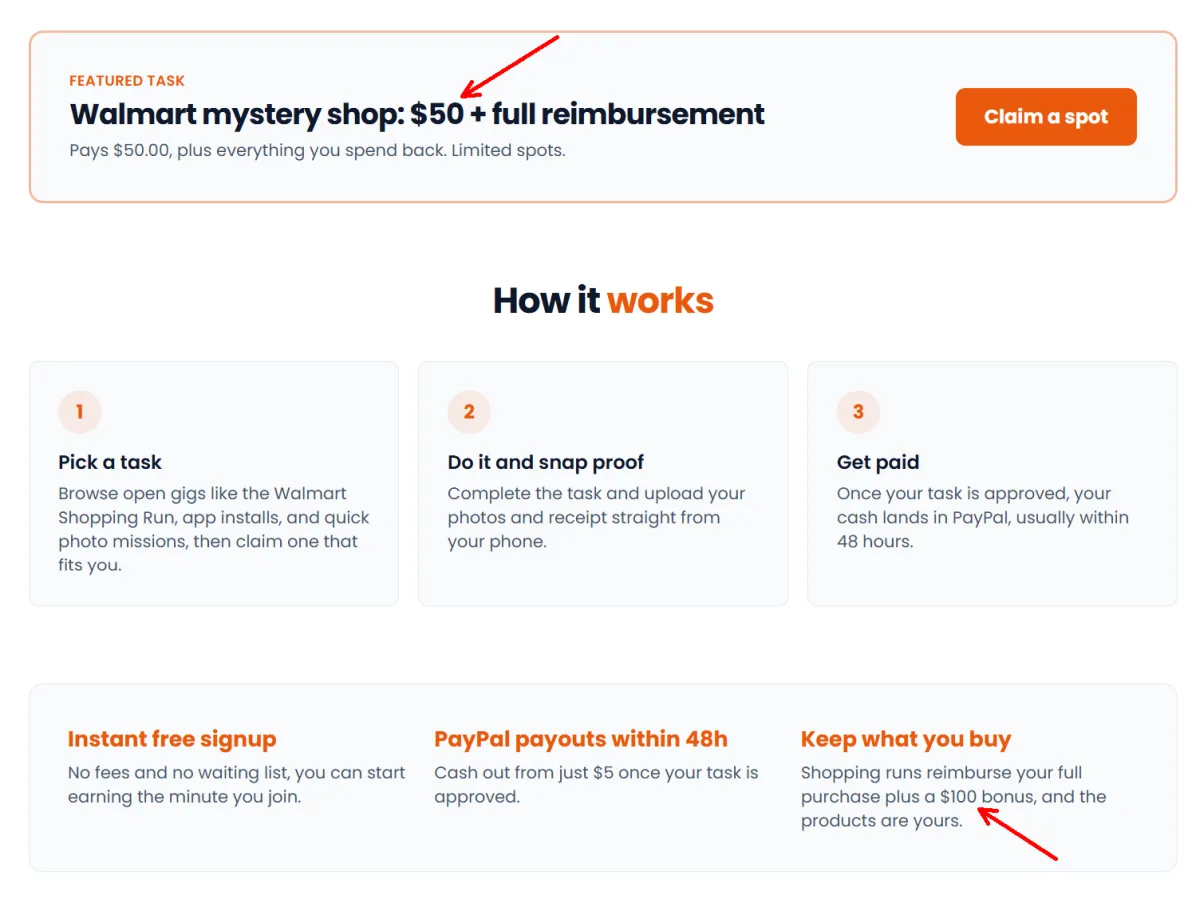
Two sections of the homepage (the How it works section and the FAQ) plus the dedicated guide page say $100. The featured task card and the stats bar on the same homepage say $50. A reader landing on the homepage sees $50 first, then encounters $100 two scrolls later. No explanation is given for the discrepancy.
The platform explicitly states it is not affiliated with Walmart. According to its own content, the money comes from brands paying for retail audits, shelf photos, and user-generated content. Spots on each run are limited and close once claimed.
The platform's Walmart guide page includes a section titled "The Fake Version: Walmart Mystery Shopper Scams" that describes the well-known fake-check fraud (check arrives → deposit it → buy gift cards → wire back the difference → check bounces) and explicitly distances the platform from that pattern. This is relevant context: the get paid to shop at Walmart niche has a genuine reputation problem, and the platform is aware of it.
What Micromoola actually is
Micromoola is a micro-task platform operated by a company called BroadHoldings. According to its own pages, it connects users with simple paid tasks: in-store shopping runs, app installs, and photo missions. The platform states that payouts go through PayPal, signup is free, and no payment information, SSN, or bank logins are required. Users must be 18 or older.
The domain Micromoola.com was registered approximately 11 months ago according to WHOIS data. The platform claims to have been paying members since 2024. Blog post URLs still contain the slug "broadtasks" (for example, /blog/how-broadtasks-works and /blog/is-broadtasks-legit), indicating the platform was previously called BroadTasks and was rebranded without updating all internal links.
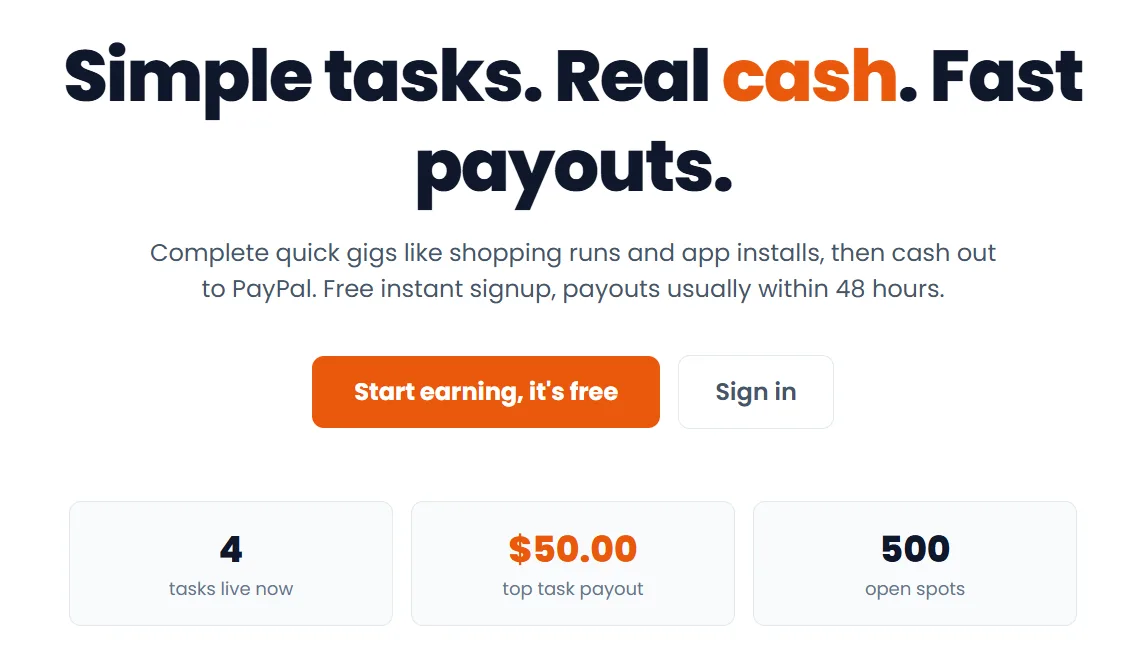
The homepage displays three stats: "4 tasks live now," "$50.00 top task payout," and "500 open spots." The About page describes the business model: brands pay Micromoola for in-store photo audits, price checks, product verification, and verified app installs. Micromoola posts these as tasks and passes a cut to the user who completes them.
The platform positions itself against competitors like Freecash and Swagbucks (which use points systems and offer surveys) and Field Agent, Gigwalk, Observa, and iVueit (which focus on in-store photo work). Micromoola's stated differentiator is cash-only payouts with no points conversion, a $5 minimum, and higher-value in-store tasks.
You are playing by someone else’s rules
You are essentially building a castle on rented land—they can change their algorithm, cut your payouts, or suspend your account overnight.
Want to build something you actually own and control? Here are a few alternatives:
Open spots that shrink, then vanish
The availability numbers disagree with each other depending on which page you read. The homepage stats bar claims "4 tasks live now" and "500 open spots."
The public Open tasks page (the "Open right now" link) showed a header reading "3 tasks open" and "99+ places left" at the time of testing. After signing in from Spain, the member board read "0 open spots." Three pages, three different numbers for the same thing.
- "Walmart mystery shop: $50 + full reimbursement" — 60 places left — restricted to AZ, NV (in-store)
- "Try 5 free iPhone apps: $15" — 148 places left — "Anywhere in the US"
- "Try 5 free iPhone apps: $10" — 143 places left — "Anywhere in the US"
So of the three publicly advertised tasks, one was in-store (and limited to just two states) and two were app installs. The important detail is that both app installs carried the tag "Anywhere in the US", not "worldwide." The FAQ suggests online tasks "may be open to a wider audience depending on the task," and the app install page says offers "vary by brand." At the time of testing, however, not a single public task accepted a user outside the US.
After signing in from Spain, the board was empty: stats reading "0 open spots" and the message "No tasks in this category right now. Check back soon." The only cards on screen sat under a "RECENTLY FILLED, GONE FAST" heading — three exhausted offers (an app install at $25, an app review at $15, an app install at $3), each stamped "All spots taken." None of them could be claimed.
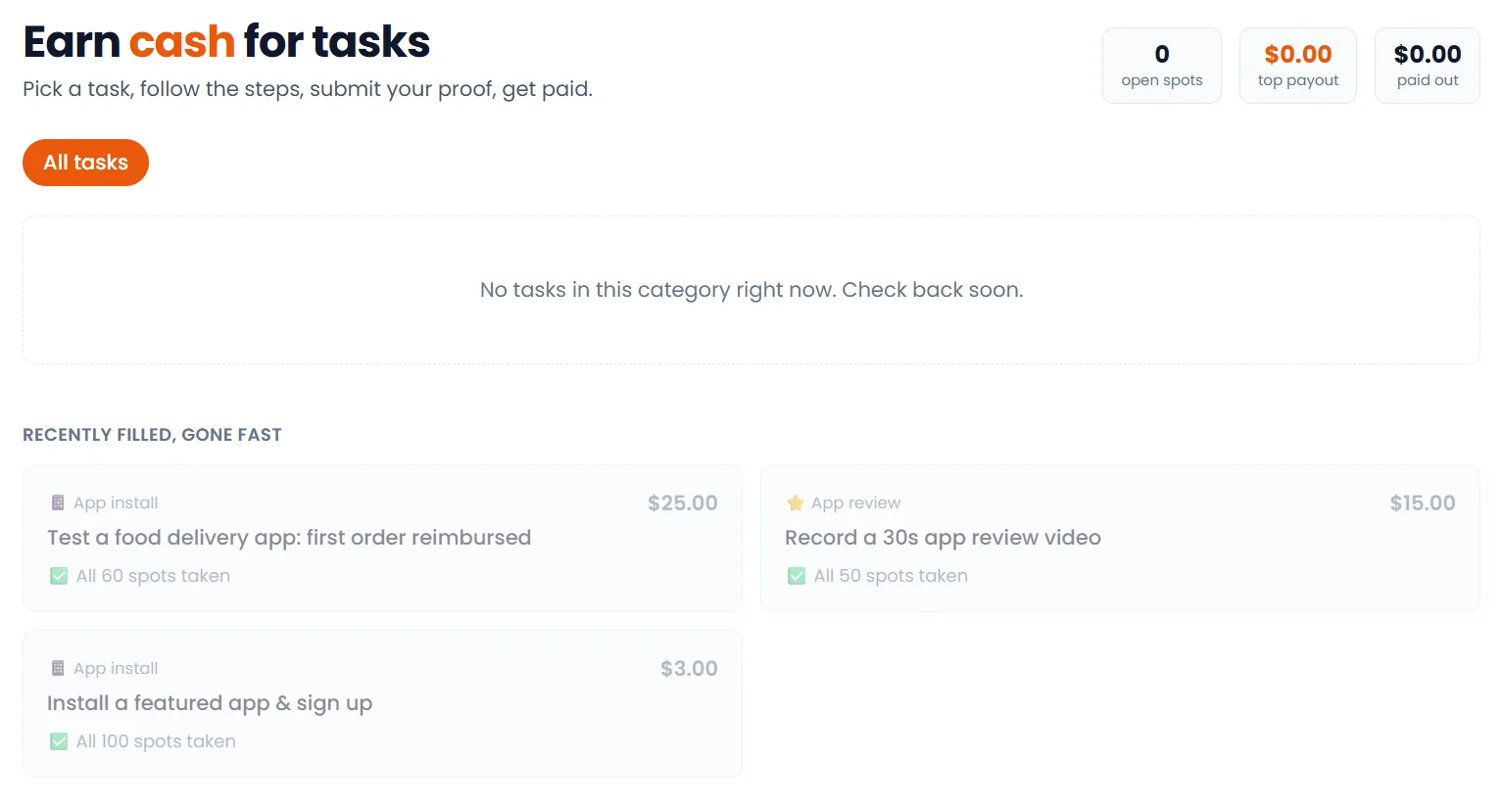
For readers outside the US, the practical result is blunt: you can create an account, but at the time of testing there was not one task you could actually take. Even app installs — the category the platform elsewhere describes as potentially global — were tagged US-only. What remains is waiting for a task that may one day include your region, with no certainty that it ever will.
3 payout timelines on 1 website
Micromoola's payment terms are stated differently in three places on the same website:
- Main content pages and FAQ: "Payouts usually land within 48 hours of task approval." This appears on the homepage, the About page, all earn guides, and the FAQ.
- Site footer (every page): "Payouts via PayPal · $5 minimum · usually 1-4 hours, always within 24h."
- Terms of Service: "Withdrawals usually arrive within 1-4 hours of approval, and always within 24 hours."
The marketing pages promise 48 hours. The footer and the legally binding Terms promise 1–4 hours with a 24-hour maximum. These are not the same claim. A user reading the FAQ expects a two-day wait. A user reading the Terms expects same-day payment.
The full realistic timeline, based on the marketing pages, is: 24–48 hours for human proof review, plus up to 48 hours for the PayPal payout after approval. That is up to four days from task completion to money in your account. The platform's blog post on PayPal payouts confirms this: "Worst realistic case, you are looking at about four days from finishing a task to money in your PayPal."
Other payment details: the minimum withdrawal is $5, there are no fees, PayPal is the only stated payout method (no gift cards, no crypto, no points), and rejected payouts refund to your balance rather than disappearing.
What you can realistically earn
Micromoola lists four task categories:
- Walmart Shopping Runs: Full reimbursement of 5 products plus a cash bonus ($50 or $100, depending on which page you read). US-only. Limited spots.
- App installs: From approximately $0.10 for a simple install-and-try task up to $20+ for multi-step offers requiring in-app actions. You must complete a listed action (create an account, reach a level); the install alone does not pay.
- Photo missions: $2–$20 per job industry-wide, with complex assignments reaching $100. You photograph shelves, products, and price tags in stores. US-only for in-store missions.
- Rolling micro-tasks: Smaller one-off jobs posted as brands request them.
The platform positions earnings as "side money, not a salary." Its own content states that casual users across a stack of earning apps typically make $50–$150 per month, while power users who check daily and claim tasks fast report $300 or more. Every task displays its payout, requirements, and a rough time estimate before you claim it.
Micromoola also runs a referral program: you earn $1 USD for each referred user who completes their first task. No tiers, volume bonuses, or recurring commissions are mentioned in any of the platform's public pages.
One structural point worth noting: you front the money on shopping runs. The purchase is reimbursed after approval, not at the register. If a Walmart run costs you $40–$60 at checkout, that money is tied up for up to four days. The platform acknowledges this: "If floating a Walmart run for a couple of days is a stretch, start with a smaller task first."
A blank jurisdiction in the Terms
The Terms of Service (last updated July 23, 2026) and the Privacy Policy (same date) both contain this sentence: "These Terms are governed by the laws of [GOVERNING LAW JURISDICTION], without regard to its conflict-of-laws principles."
The bracketed placeholder was never replaced with an actual jurisdiction. After 11 months of operation, the legal document governing user agreements does not specify which country's or state's laws apply. This means that in a dispute, neither the user nor the platform has a contractually agreed forum for resolution.
Beyond the placeholder, several clauses in the Terms deserve attention:
- One submission per task: "Each claimed task allows a single proof submission. Duplicate or resubmitted proof for the same task instance is not permitted and will be rejected." This contradicts the marketing pages and FAQ, which state that rejections "can usually be fixed and resubmitted." The Terms add a qualifier — "Where a task permits it, you may correct and resubmit proof before the deadline" — but the default rule is one attempt.
- Forfeiture of balance: Account termination for fraud, multiple accounts, bots, or location spoofing results in forfeiture of the entire unpaid balance.
- Content license: By submitting photos and receipts, you grant Micromoola a "non-exclusive, worldwide, royalty-free, sublicensable license" to use and share those materials with the client brands that commissioned the task.
- Task changes without notice: The platform may "add, modify, limit, or remove available tasks, reward amounts, or instructions at any time without notice."
- Liability cap: Total aggregate liability is limited to the amount of your unpaid, approved balance.
On data handling: the platform collects geolocation and timestamp data at the moment of proof submission (with device permission). Declining location access may prevent you from completing certain tasks. Photos and receipts are shared directly with the brand client who commissioned the task. The Privacy Policy explicitly states that personal data is not sold to third parties.
Who should try Micromoola
Micromoola fits a narrow profile. You are a reasonable candidate if:
- You live in the US and can physically visit a Walmart.
- You want a one-off or occasional side payout, not a recurring income stream.
- You are comfortable fronting $40–$60 for up to four days while waiting for reimbursement.
- You accept that the platform is new, unverified by third parties, and may change or disappear.
You should look elsewhere if:
- You live outside the US. Based on my testing, the member board showed zero open tasks, and the public app install tasks were also tagged US-only, so even the remote lane was closed at the time of testing. The platform's own language confirms a "lower earning ceiling" for non-US users, but the reality in testing was no tasks at all.
- You need predictable, consistent income. Task availability depends on brand campaigns, spots are limited, and the platform can change reward amounts without notice.
- You are uncomfortable with a platform that has no independent reviews, contradictory information on its own pages, and an unfinished legal document.
- You want to build an asset that appreciates over time rather than trading hours for one-off payouts controlled by a third party.
For readers in the last category, building a simple website that earns through product reviews and recommendations offers something Micromoola cannot: income you control, that isn't gated by geography, and that doesn't disappear if a platform shuts down. My guide on how to get paid to review products online covers one practical starting point that uses skills you already have.