


- 30-second summary
- Is taking YouGov surveys worth it?
- My personal test: Paid ads, zero surveys
- The reality of slow earnings and high thresholds
- Speeding up points with passive data sharing
- The panel promise versus automated quality checks
- Account bans, missing codes, and vanishing points
- Regional frustrations and virtual card limitations
- Privacy, data collection, and AI training rules
- Who should actually use this platform?
- Frequently asked questions
- Sources
30-second summary
YouGov is a legitimate, globally recognized market research platform that respects your time by rarely disqualifying you halfway through a survey.
However, the path to actually cashing out is incredibly slow, accompanied by high payout thresholds, frequent technical login issues, and sudden account suspensions.
Pros
- No mid-survey disqualifications
- Surveys often appear in media
- Passive earning via data sharing
- Legitimate global research company
Cons
- High payout thresholds
- Frequent login code delivery failures
- Accounts locked near payout limits
- Points expire after 12 months
Is taking YouGov surveys worth it?
Yes, if you want to share your opinions on meaningful political and social issues and actually see your aggregated answers cited in major news outlets without the frustration of mid-survey screen-outs.
No, if you need reliable income and want to avoid building your earnings on a platform that can suspend your account right before you reach the payout limit. Instead of trading your personal data for pennies, consider building an asset you fully control by learning how to earn money by displaying ads on your website.
My personal test: Paid ads, zero surveys
To test this earning opportunity, I registered for an account. I received 50 points just for signing up, and the platform immediately presented an introductory survey asking for basic demographic data.
Completing that initial profile awarded me another 125 points. However, after that single questionnaire, the member dashboard was completely empty. There were no further surveys available to take.
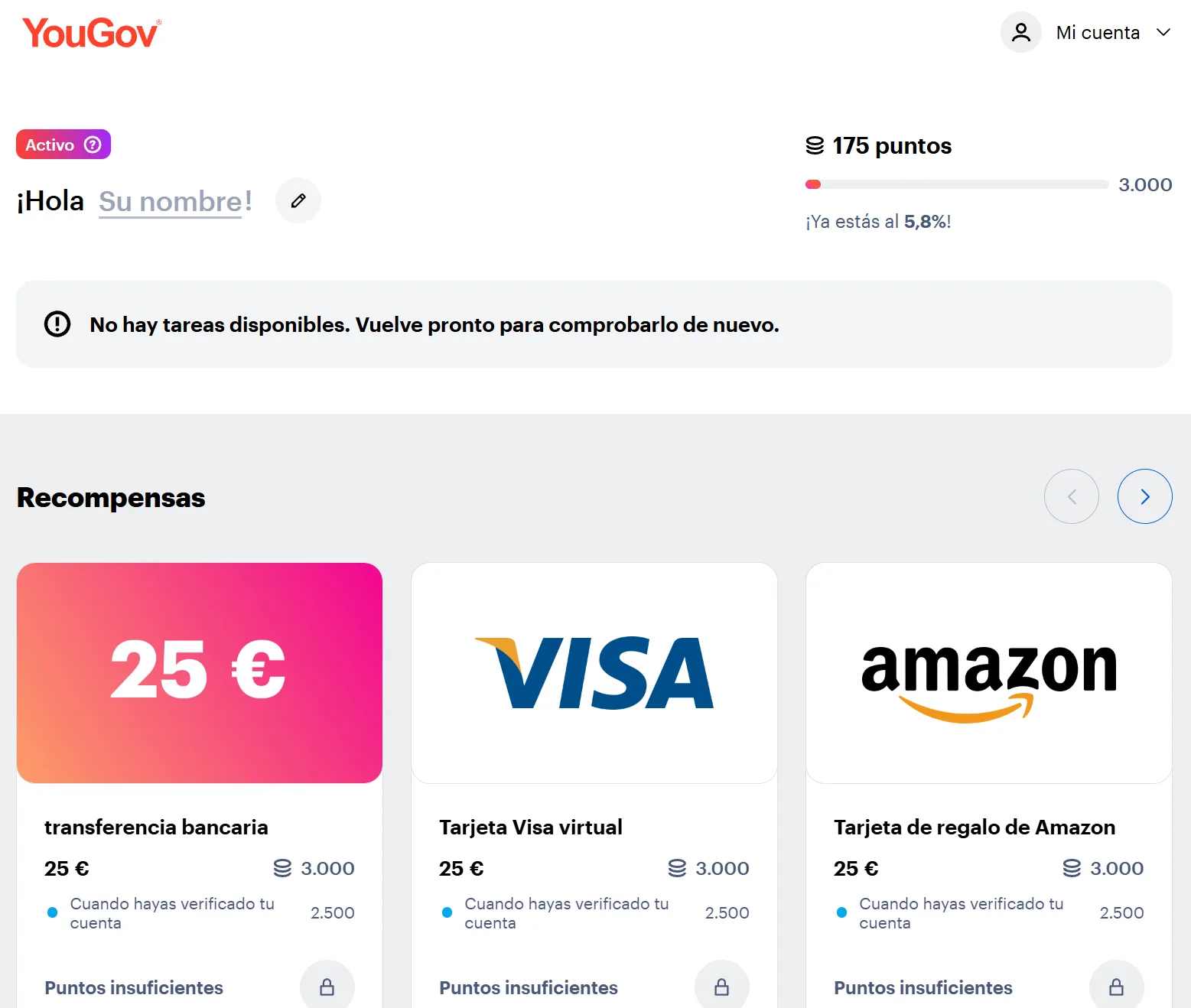
I found this particularly surprising because I originally discovered YouGov through a paid Facebook advertising campaign. The company is actively spending money to acquire new users, yet they had no actual work for me to do once I joined. Because the dashboard remained empty, my personal testing ended right there.
The reality of slow earnings and high thresholds
YouGov operates differently from standard survey sites. Instead of letting you browse a list of available questionnaires, the platform uses a method called active sampling. I found that this means the company specifically invites you to take surveys based on the detailed demographic profile you build during registration.
The frequency of surveys is highly unpredictable. A substantial number of Reddit and Trustpilot reviews from 2021 to 2025 mention going weeks or even months without a single opportunity.
To cash out, you must reach extremely high thresholds that vary dramatically by region. In the UK, the minimum is 5,000 points for £50. In the EU, my test showed a threshold of 3,000 points for €25. But in the US, a significant portion of user discussions from 2023 to 2026 note that you need between 30,000 and 55,000 points just to claim $15 to $50.
Based on user experiences across multiple forums, it routinely takes several months to over a year of consistent participation to finally reach that first payout milestone.
Speeding up points with passive data sharing
To bypass the slow trickle of survey invites, a large segment of the user base on Reddit turns to passive data-sharing features like YouGov Safe and YouGov Finance.
- YouGov Finance allows you to connect your bank accounts via Open Banking to earn points for sharing your transaction history.
- YouGov Safe lets you link streaming services like Netflix or YouTube to earn points based on your viewing habits.
While these tools can significantly boost your balance, they come with their own set of technical glitches. A recurring complaint across Reddit threads and Google Play reviews from 2024 to 2026 details broken synchronization, missing verification codes during the linking process, and sudden disconnections that halt the passive point generation.
You are playing by someone else’s rules
You are essentially building a castle on rented land—they can change their algorithm, cut your payouts, or suspend your account overnight.
Want to build something you actually own and control? Here are a few alternatives:
The panel promise versus automated quality checks
The most praised feature of YouGov is its Panel Promise. Because the platform pre-screens you based on your profile, you almost never experience the common screen-out—where a survey kicks you out halfway through because you do not fit the target demographic.
If you receive an invite, you are generally guaranteed to complete it and receive the promised points. Furthermore, a majority of positive reviews on Trustpilot from 2024 to 2026 highlight the intellectual stimulation of the surveys and the pride members feel when their aggregated opinions shape public debates or appear in the media.
However, this system is not flawless. A smaller group of users on SurveyPolice and Reddit reported being disqualified due to automated quality checks. In these rare cases, members received only a fraction of the promised points or nothing at all.
Crucially, the official Member Terms & Conditions give the company the right to reduce or withhold points if their algorithms suspect your participation falls below acceptable quality standards. This legal clause directly contradicts the spirit of the Panel Promise in the eyes of frustrated users.
Account bans, missing codes, and vanishing points
The most concerning pattern I noticed across a significant portion of 1-star reviews on Trustpilot and SurveyPolice from 2023 to 2026 involves accounts being locked or suspended just as users approach the payout threshold.
A recurring theme in SurveyPolice complaints from 2024 to 2026 shows that long-term members report the platform suddenly stops sending survey invites. Others face severe technical barriers, specifically with the two-factor authentication login system.
The site often requires a one-time code sent to your email to log in. A recurring complaint across multiple forums details how this code simply never arrives, effectively locking users out of accounts holding thousands of points. When they contact support, they are met with automated replies or complete silence.
From a legal standpoint, you have very little recourse. The official Member Terms & Conditions explicitly state that points have no cash value, are non-transferable, and can be revoked at the company's sole discretion. Additionally, if your account remains inactive for 12 consecutive months, your points will expire and the account may be deactivated.
Regional frustrations and virtual card limitations
Your experience with cashing out depends heavily on where you live. While users in the US or UK might easily choose PayPal or direct bank transfers, members in other regions face significant hurdles.
In many Latin American countries, a large number of Google Play reviews from 2023 to 2026 complain that the platform removed PayPal as an option. Users are now forced to accept virtual Visa cards issued by a third-party service called Tremendous.
A large segment of Latin American users on Google Play from 2023 to 2026 complains that these virtual cards are rejected by local online merchants or physical stores. Furthermore, economic realities severely impact the value of your rewards. For example, users in Argentina reported that cashing out 25,000 points yields 250 ARS (Argentine pesos), which equates to roughly $0.27 USD due to extreme inflation and unfavorable exchange rates.
Privacy, data collection, and AI training rules
Because YouGov is a data analytics company, they collect deep behavioral, demographic, and sometimes sensitive information about you. On forums like Quora, some users mistakenly claim the company sells their personal, identifiable data to third-party brokers.
The official Privacy Policy explicitly denies this. Your survey responses are anonymized and aggregated before being sold to clients.
However, you are still giving up a lot of privacy. According to section 4 of the Member Terms & Conditions, you grant the company a perpetual, royalty-free license to use your content. This explicitly includes using your responses to train and develop artificial intelligence systems, build predictive models, and create commercial products.
Who should actually use this platform?
YouGov is best suited for patient individuals who enjoy sharing their political and social opinions and do not mind waiting months for a small reward, while those seeking reliable income should look into alternatives like renting websites to local businesses where you set your own rules and own the asset.
If you want to build a sustainable online income that does not depend on a third-party platform's arbitrary algorithms or sudden account bans, I highly recommend exploring models where you control the infrastructure.